
Views: 0 Author: Site Editor Publish Time: 2026-10-23 Origin: Site
Selecting an underground drilling jumbo requires more than comparing drilling power or equipment dimensions. Different mines have different geological conditions, tunnel profiles, production targets, and operating constraints. A machine that performs well in a large development heading may not be the most practical option for a narrow-vein mine.
The right equipment should match the rock conditions, heading dimensions, drilling requirements, and underground working environment. This guide explains the key selection factors for different mine conditions and shows how to evaluate a development drilling jumbo for long-term productivity and operating efficiency.
Understand Your Mine's Geological Conditions
Match the Drilling Jumbo to Heading Dimensions
Choose the Right Drilling Performance and Boom Configuration
Evaluate Mobility and Underground Working Conditions
Consider Maintenance, Safety, and Operating Costs
Underground Drilling Jumbo Selection for Different Mine Conditions
Why Consider FAMBITION for Underground Drilling Equipment?
Frequently Asked Questions
Geological conditions are among the most important factors when selecting an underground drilling jumbo. Rock strength, abrasiveness, joint distribution, and geological variability all influence drilling efficiency, tool wear, and equipment maintenance requirements.
Before comparing a mining drill rig's specifications, evaluate the geological characteristics of the working area.
Hard rock generally requires an appropriate combination of percussion energy, feed force, rotation, and drilling control. If the rock drill does not provide sufficient performance for the rock conditions, penetration rates may decrease and drilling cycles may become longer.
However, choosing the highest available drilling power is not always the best solution. Excessive or poorly matched drilling parameters can increase stress on drilling tools and accelerate component wear.
For mines with medium-hard to hard rock, consider:
Rock drill percussion power and its suitability for the expected rock strength.
Anti-jamming functions that help manage changes in drilling resistance.
Feed control and rotation performance for stable hole advancement.
Drill steel and bit durability under the site's actual rock conditions.
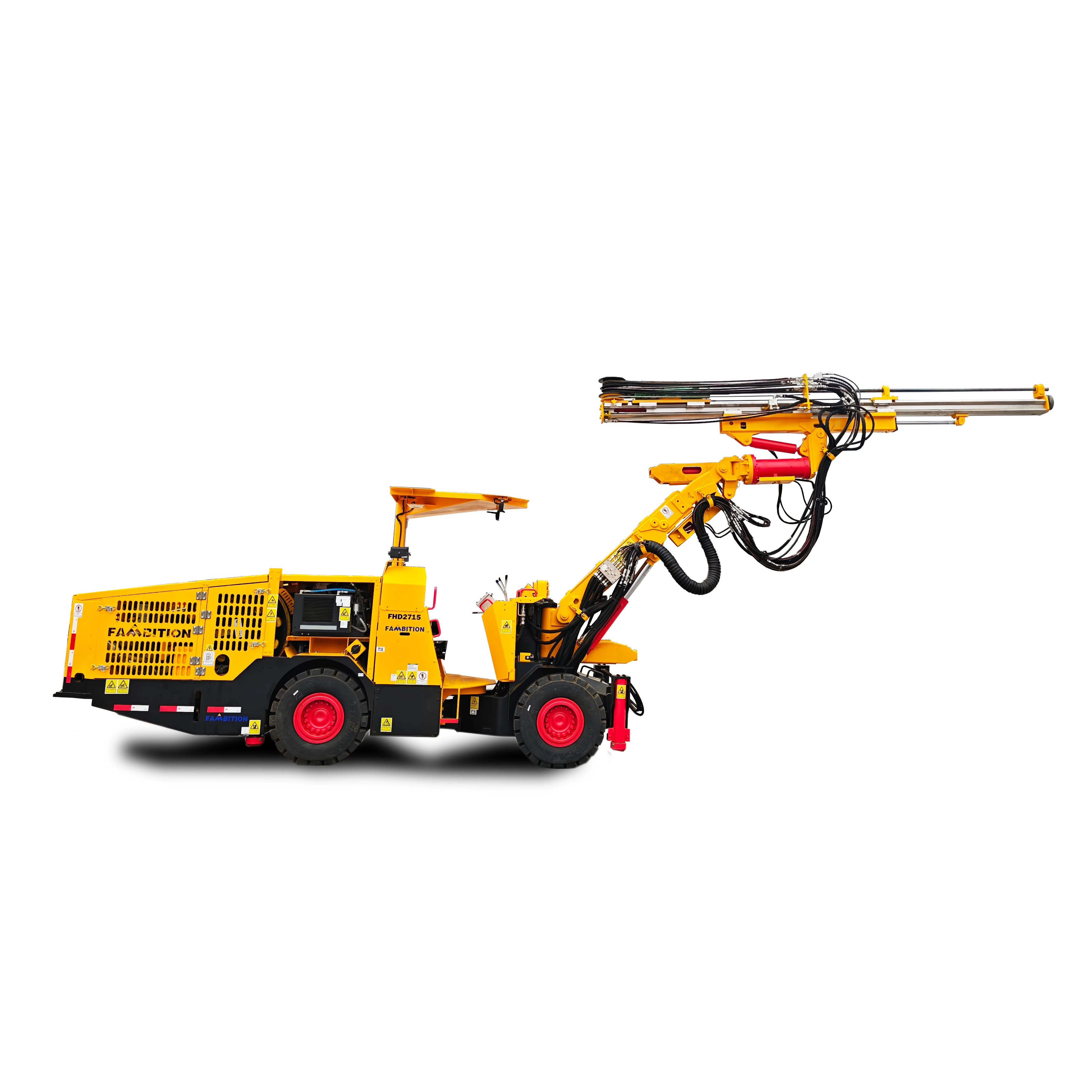
For example, FAMBITION's FHD2715 development drilling jumbo is equipped with a MONTABERT HC95 hydraulic rock drill rated at 20 kW of percussion power according to its product specifications. Its dual-buffer and anti-jamming design supports drilling across different rock conditions.
Rock hardness and abrasiveness are related but different characteristics. Highly abrasive rock can accelerate drill bit and drill steel wear, even when its strength does not require the highest percussion power.
Geological variability creates another challenge. A mine may encounter different rock conditions within the same development area, requiring the drilling system to respond to changes in resistance.
When evaluating an underground drilling jumbo, consider the following questions:
Does the drilling system support stable operation under changing rock conditions?
Are replacement drilling tools readily available?
Can the equipment maintain consistent hole positioning and depth?
How easily can maintenance teams access the rock drill and related components?
The goal is to match drilling performance to actual geology while controlling consumable costs and unplanned downtime.
The dimensions of underground headings directly affect equipment compatibility, maneuverability, and drilling coverage. A jumbo may offer excellent drilling performance but still be unsuitable if it cannot enter the working area or position its boom effectively.
Before selecting a machine, establish the minimum and maximum dimensions of the headings in which it will operate.
Important measurements include:
Heading width and height
Required drilling coverage across the face
Available clearance for equipment movement
Space occupied by ventilation ducts, pipes, and cables
Turning space at intersections and crosscuts
The machine's transport dimensions must also be considered. Underground access routes may be narrower than the working heading itself, creating additional constraints during equipment movement.
FAMBITION's FHD2715 drilling jumbo is designed for development drilling in narrow-vein and mass mining, as well as tunneling. Its product specifications describe drilling applications in cross sections of up to 34 m², with listed operating environments ranging from approximately 2.7 m × 3.0 m to 6 m × 6 m.
These figures provide a useful reference for preliminary screening, but the actual machine dimensions, transport clearance, and required drilling coverage should be verified against the mine's engineering drawings.
A drilling jumbo must reach the required drilling positions across the entire face without unnecessary repositioning.
Insufficient boom coverage can increase auxiliary time and reduce the number of completed holes per shift. Excessive machine size, meanwhile, may create maneuverability problems in narrow headings.
When evaluating a development drilling jumbo, review:
Boom reach and working envelope
Feed rotation and positioning capability
Automatic parallelism functions
Required hole angles and depths
Clearance between the boom, tunnel walls, and installed services
A suitable machine should achieve the required drilling pattern while allowing the operator to position it safely and efficiently.
Different underground mining operations have different production requirements. The appropriate drilling configuration depends on the number of holes per round, required advance per cycle, heading dimensions, and available working time.
A single-boom drilling jumbo can be suitable for narrow headings, localized development work, and mines where compact dimensions and maneuverability are important.
Potential advantages include:
Compact equipment layout for restricted working areas
Easier maneuvering through narrow intersections
A simpler drilling configuration to inspect and maintain
Flexibility for development headings and smaller tunnels
FAMBITION's FHD2715 is a single-boom electro-hydraulic development drilling jumbo designed for narrow-vein mining, mass mining, and tunneling.
Its drill arm features 360-degree feed rotation and automatic parallelism, supporting accurate positioning across the required face profile.
Drilling productivity should not be judged by penetration rate alone. The complete development cycle also includes machine positioning, boom movement, rod handling where applicable, drilling-pattern execution, and equipment movement between headings.
A faster individual hole does not automatically translate into a higher daily advance rate.
Mine planners should evaluate the following operating data:
| Evaluation Factor | What to Check | Why It Matters |
|---|---|---|
| Holes per round | Number and layout of planned holes | Determines drilling workload |
| Hole depth | Required depth for each drilling pattern | Influences drilling time and advance per round |
| Rock conditions | Strength, abrasiveness, and variability | Affects penetration and tool wear |
| Face coverage | Required width and height | Determines boom positioning requirements |
| Auxiliary time | Setup, repositioning, and equipment movement | Influences total cycle time |
| Equipment availability | Planned maintenance and unexpected downtime | Affects productive operating hours |
For larger headings or operations with high drilling volumes, multi-boom equipment may be worth evaluating. However, boom configuration should be selected according to the mine's actual production plan and available space, not solely on the number of booms.
Always confirm the manufacturer's available product configurations before specifying a multi-boom solution.
Underground equipment must operate within confined spaces, navigate uneven floors, and move between working areas safely. Mobility is therefore a critical part of drilling jumbo selection, especially in narrow-vein mines and complex development networks.
A machine with a suitable turning radius can navigate tight intersections more efficiently. Four-wheel drive, steering geometry, ground clearance, and chassis stability also influence its ability to move through underground access routes.
FAMBITION's FHD2715 uses a four-wheel hydrostatic drive chassis and central articulated steering. According to the product specifications, these features support maneuverability in small mining drifts and tunnels.
When comparing a mining drill rig's mobility, assess:
Minimum turning radius
Tramming dimensions and ground clearance
Road gradients and floor conditions
Traction on wet or uneven surfaces
Stability during positioning and drilling
The selected machine should be compatible with the entire route between the maintenance area, access ramp, and working heading.
Underground mines may have high humidity, limited ventilation, water ingress, and restricted visibility. These conditions can affect electrical components, hydraulic systems, operator comfort, and maintenance requirements.
The working environment should be considered alongside drilling performance.
Review the protection ratings of electrical equipment, hydraulic component accessibility, cooling requirements, and the maintenance procedures recommended for the intended environment.
Diesel-powered equipment also requires careful coordination with the mine's ventilation plan. Engine emissions, heat output, and air quality requirements should be evaluated before deployment.
For mines with specific environmental or operational requirements, contact the manufacturer to confirm whether the proposed configuration is suitable for the site.
Purchase price is only one part of the cost of operating an underground drilling jumbo. Maintenance, drilling consumables, energy consumption, downtime, and operator requirements can all influence the total cost of ownership.
Easy access to critical components can reduce maintenance time and improve equipment availability.
When evaluating a drilling jumbo, check access to the rock drill, hydraulic system, filters, lubrication points, and other service items. Ask the supplier about recommended maintenance intervals, spare parts availability, and technical support arrangements.
It is also useful to establish which maintenance tasks can be completed on-site and which require specialist support.
A machine with competitive drilling performance may still generate high operating costs if replacement components are difficult to obtain or maintenance procedures are unnecessarily complicated.
Safety features should be assessed against the mine's regulatory requirements and operating procedures.
For example, FAMBITION's FHD2715 product specifications list a FOPS-approved safety canopy and an adjustable roof. These features should be evaluated alongside visibility, access and egress, controls, and the mine's required operator protection standards.
Before purchase, confirm the applicable certifications and safety provisions for the intended machine configuration and operating jurisdiction.
A practical comparison should include more than the initial equipment price.
| Cost Category | Key Questions |
|---|---|
| Acquisition | Does the machine meet the required technical specifications? |
| Drilling consumables | What are the expected bit and drill steel replacement requirements? |
| Maintenance | How frequently are inspections and component servicing required? |
| Downtime | How quickly can faults be diagnosed and repaired? |
| Energy and ventilation | What are the power requirements and associated site costs? |
| Training and support | What operator training and technical assistance are available? |
The most cost-effective underground drilling jumbo is the one that meets production targets reliably over its service life, rather than simply offering the lowest purchase price.
The following table summarizes how common mine conditions can influence equipment selection.
| Mine Condition | Main Challenges | Key Selection Priorities |
|---|---|---|
| Narrow-vein mining | Restricted headings and tight turning spaces | Compact chassis, small turning radius, suitable boom coverage |
| Medium-hard to hard rock | Drilling resistance and tool wear | Appropriate percussion power, stable feed control, durable drilling components |
| Highly abrasive rock | Accelerated bit and drill steel wear | Consumable durability, maintenance access, spare parts support |
| Variable geological conditions | Changes in drilling resistance | Anti-jamming functions, adjustable drilling parameters, stable control |
| Humid underground environments | Moisture exposure and maintenance demands | Suitable component protection, accessible service points, environmental compatibility |
| High-volume development | Large drilling workload and cycle-time pressure | Required face coverage, drilling efficiency, operating availability |
| Restricted access routes | Limited transport clearance and maneuvering space | Machine dimensions, transport configuration, steering and traction |
These priorities are not mutually exclusive. A single mine may combine narrow headings, hard rock, high humidity, and ambitious development targets.
The final equipment specification should reflect the combination of geological, geometric, and operational conditions at the site.
FAMBITION's FHD2715 project case in Türkiye illustrates why equipment selection should be based on real working conditions.
The project describes a bauxite mine with a development heading of approximately 3.5 m × 3.5 m, rock hardness of 7–8 on the Mohs scale, and a humid underground environment.
The reported drilling pattern used 45 mm blast holes with an average depth of 3.2 m and approximately 50–55 holes per development round. The project report recorded an average drilling time of around 1 minute and 30 seconds per hole.
These figures are specific to the reported project and its operating conditions, not guaranteed performance figures for every mine.
The example highlights several important considerations: the equipment must fit the heading, provide appropriate drilling performance for the rock, maintain maneuverability in confined spaces, and operate reliably in the underground environment.
FAMBITION manufactures underground mining equipment, including underground loaders, mining trucks, utility vehicles, and development drilling jumbos. Its Drilling Jumbos product range includes the FHD2715 single-boom electro-hydraulic model.
When evaluating FAMBITION equipment for an underground mining project, buyers can review several practical aspects.
The FHD2715 combines a compact single-boom configuration, hydrostatic four-wheel drive, and central articulated steering. These characteristics make it relevant for projects where maneuverability and drilling coverage must be balanced.
The product's hydraulic rock drill, dual-buffer design, and anti-jamming function support its intended development drilling applications. The suitability of these features should be confirmed against the site's rock strength, abrasiveness, and required drilling pattern.
Buyers can review the FHD2715 product specifications and the Türkiye drilling jumbo project when preparing an initial equipment assessment.
For more detailed technical information, the FAMBITION Technology page provides information about its research, testing, and engineering capabilities.
Before placing an order, provide the supplier with the mine layout, geological data, drilling pattern, production targets, and operating constraints. This information helps determine whether the available machine configuration meets the project's actual requirements.
There is no single factor that applies to every mine. Heading dimensions and geological conditions should be assessed first, because they establish the basic equipment requirements. Drilling performance, mobility, safety, and maintenance costs should then be evaluated against the mine's production targets.
A single-boom jumbo can be suitable for hard-rock development if its rock drill, feed system, and drilling controls meet the site's requirements. Rock hardness alone does not determine suitability; heading size, abrasiveness, drilling pattern, and expected productivity must also be considered.
Start with the smallest access route and the largest working heading. Compare these dimensions with the machine's transport envelope, turning radius, and drilling coverage. Confirm the complete machine dimensions and operating envelope with the manufacturer before finalizing the selection.
Focus on matching drilling parameters to the rock, selecting durable consumables, reducing unnecessary repositioning, maintaining critical components, and improving equipment availability.
A lower total cost of ownership depends on consistent performance and controlled downtime, not just a lower initial purchase price.
Prepare the following information:
Mine type and geological conditions
Minimum and maximum heading dimensions
Rock hardness and abrasiveness
Required hole diameter and depth
Number of holes per round and production targets
Underground access and ventilation conditions
Maintenance, safety, and environmental requirements
Providing these details helps the supplier assess equipment compatibility and recommend an appropriate configuration.
Selecting the right underground drilling jumbo requires a balanced assessment of geology, heading dimensions, drilling performance, mobility, safety, and lifecycle cost. Different mines have different priorities, so equipment should be selected according to actual site conditions rather than headline specifications alone.
FAMBITION's FHD2715 provides one example of a compact single-boom development drilling jumbo designed for narrow-vein mining, mass mining, and tunneling. Its suitability for a particular project should be verified against the mine's engineering and operating requirements.
Planning a new underground development project or upgrading your drilling fleet? Visit the FAMBITION Drilling Jumbos product page to review the available equipment, or contact the FAMBITION team to discuss your mine conditions and technical requirements.
 English


